What Actually Happens Before Anything Gets Built
The short version: this is a slow, careful, public process — not a fast track
One of the most common worries we hear about the AIM Initiative is that changing the rules will let things move too quickly, that without a citywide vote on every project, development will somehow happen overnight.
We understand the concern. So let's walk through what the approval process actually looks like, step by step. The truth is the opposite of "too fast." Even in the best-case scenario, getting a waterfront building approved and built takes years, with public input open the entire way.
What changes — and what doesn't
Today, Ordinance 1022 requires a citywide ballot vote to change land-use rules on the waterfront. That sounds like extra protection, but in practice it means almost nothing gets considered at all — which is why we've seen forty years of empty lots, deteriorating buildings, and flooding streets.
AIM doesn't remove public oversight. It returns routine land-use decisions to the normal city process that every other town in California already uses — a process governed by state law and the Sausalito Municipal Code, with multiple public hearings, professional review, and several points where neighbors can weigh in or appeal.
In other words: we're not replacing a vote with nothing. We're replacing a forty-year roadblock with a transparent, well-established process that has plenty of controls built in.
The fast track is still a multi-year journey
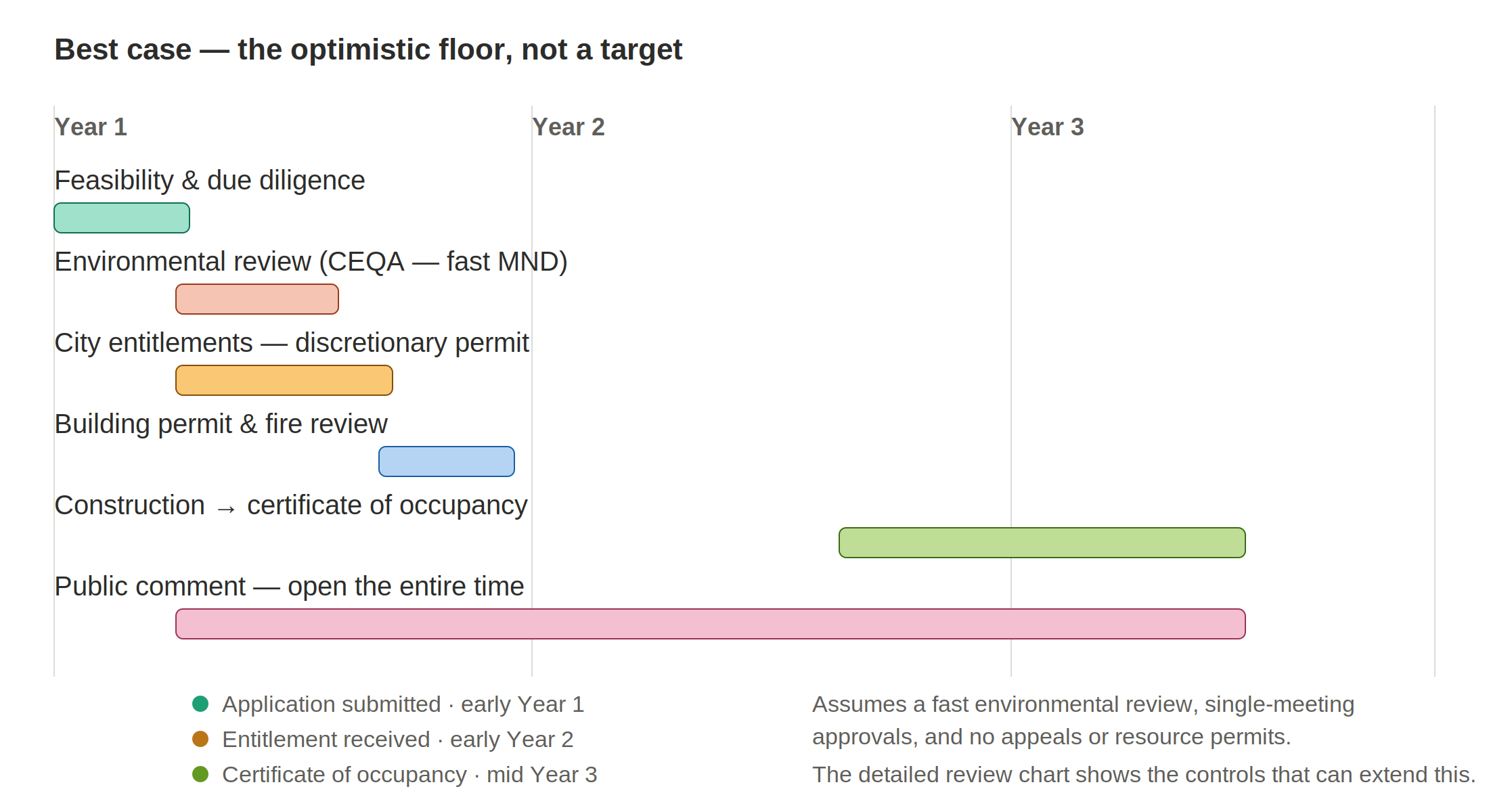
The chart below shows the best-case timeline — a project with no major problems, no resubmittals, and no appeals. Treat it as the optimistic floor, not a typical outcome.
Even in this ideal scenario:
Feasibility and due diligence comes first.
State-required environmental review (CEQA) follows — the developer has to study and disclose the project's effects on traffic, the shoreline, habitat, and more.
City entitlements — the discretionary permit and design review — happen in public.
Building and fire permits are reviewed by the Sausalito Building Department and Southern Marin Fire.
Construction then takes many more months before anyone receives a Certificate of Occupancy.
From application to a finished, occupied building, the best case runs from 2027 to 2029 — roughly two years and change. And critically, public comment is open the entire time, from the first day to the last.
Where the real controls are: the detailed review process
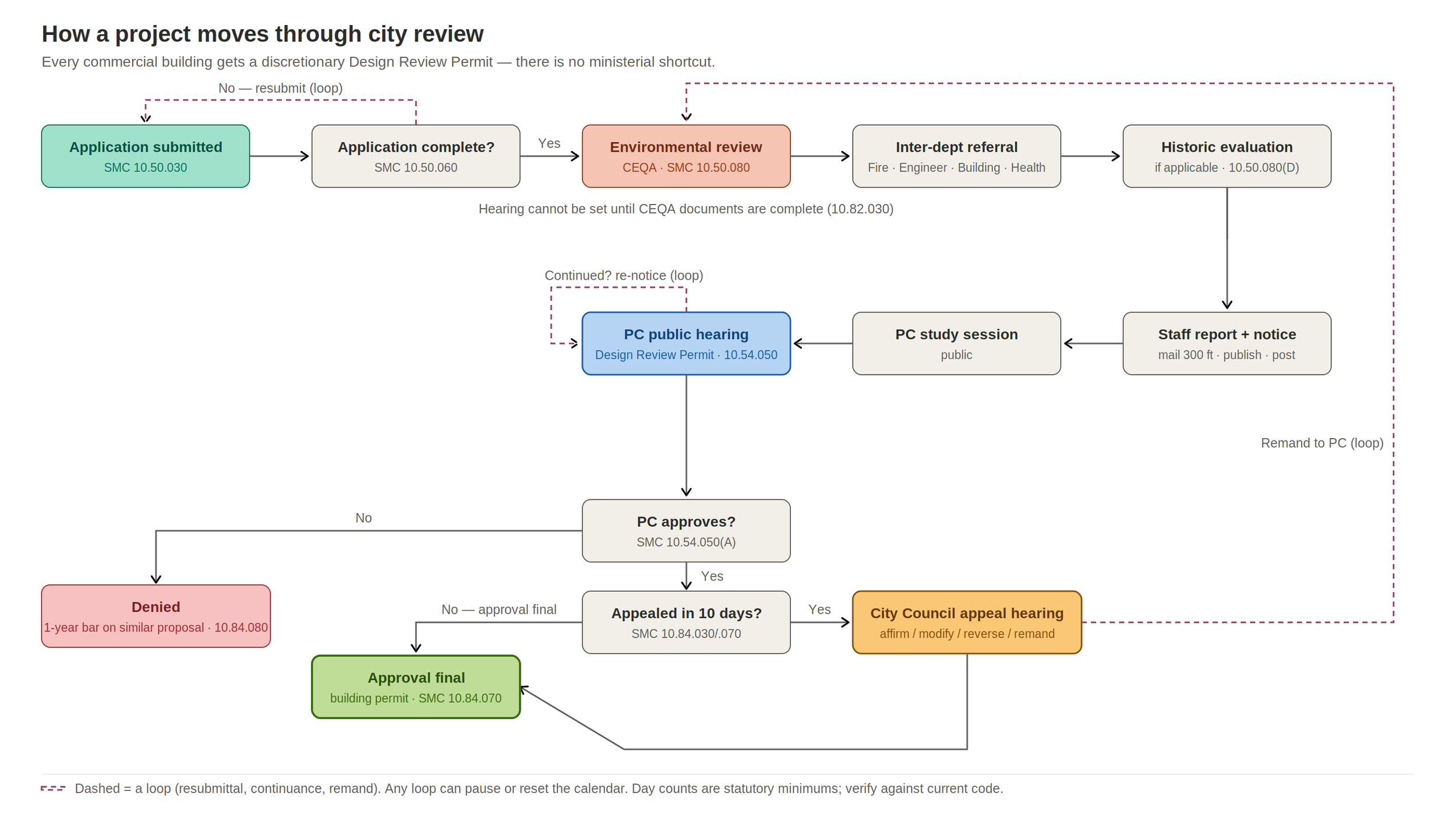
The "fast track" assumes everything goes smoothly. In reality, the city's discretionary review process has numerous checkpoints, loops, and appeal rights — any one of which can pause or stop a project. Here's what that looks like in detail.
A few things worth pulling out of that chart:
Every commercial building requires a discretionary Design Review Permit. There is no shortcut that lets a project skip review. Even a use that's allowed "by right" still goes through design review by the Planning Commission in a public hearing.
The application can be sent back. If an application is incomplete, it loops back to the applicant to fix and resubmit. The clock doesn't just run forward — it can reset.
Environmental review must finish before any hearing. Under state law, the city cannot even set a hearing until the CEQA documents are done. Comments can be raised during the environmental review windows and at the hearings.
Multiple public hearings. A project typically goes through a Planning Commission study session and then a Planning Commission public hearing — both open to the public.
Anyone can appeal. If the Planning Commission approves a project, that decision can be appealed to the City Council within 10 days. The City Council can affirm, modify, reverse, or send it back to the Planning Commission for another round.
Projects can be denied. If a project is denied, there's a one-year bar on bringing a similar proposal back.
The right to challenge in court. After approval, there are state-law windows during which the decision can be challenged in court.
The bottom line
The new process isn't a blank check. It's the same rigorous, transparent, multi-step review used across California — public hearings, professional and environmental review, appeal rights, and continuous public comment. The difference is that AIM lets good projects move through that process at all, instead of dying before they ever start.
Slow, careful, and public — with real controls at every stage. That's what AIM actually delivers.